50th pair of ODLS of order 10 was found  |
33rd pair of ODLS of order 10 was found in the current experiment (by Mixa from Russia Team and Reiner Weber). It's also the 50th pair in the project - 17 pairs were found in 2012-2013.
В текущем эксперименте найдена 33-я пара ОДЛК порядка 10 (Mixa из Russia team и Reiner Weber). Также это 50-ая пара, найденная в проекте - 17 пар были найдены в 2012-2013 гг.
|
|
| cas@home project status |
|
The main application running on CAS@home is the TreeThreader which predicts protein structure. After finishing a big campaign in Oct 2015, there have been sporadic TreeThreader jobs running on CAS@home which is around 200 sequences to predict every month. Currently, the TreeThreader application provides a public service FALCON to allow worldwide biologists submitting their protein sequences for structure prediction, and CAS@home is the backend computing platform for this public service. This service has just been open to the public, and it expects more biologists to use it in the near future with a recent publication. Apart from the jobs from FALCON, there will also be another campaign of TreeThreader between Feb and May 2016 to prepare for the CASP event . As usual, CAS@home appreciates all the support from its volunteers!
|
|
| Why there are no work units at the moment |
|
Dear malariacontrol.net community,
Apologies for not responding sooner to the lack of work-units for malariacontrol.net. We had some technical problems with our attempts to fit improved models of malaria dynamics to field data. This meant that we had to close down the generation of new work units.
We hoped that this would be a very short term problem, but over Christmas and the New Year, it was difficult to assess exactly what was going on. Unfortunately we are now faced with the challenge that for a variety of personal reasons the team members able to address these problems are currently not available, and we donât have any spare funding that we can allocate to hiring anyone new.
We are now almost at the 10th anniversary of malariacontrol.net and we are really hoping to keep this going, but it will probably be another month or two before we can get the system up again.
Malariacontrol.net has now been going for ten years, and your contributions to this over the years have been really useful- (take a look at
https://github.com/SwissTPH/openmalaria/wiki ).
Instead of this apology, we would really like to be sending you all a big thank you!
|
|
| About GULP Application |
New application aimed at testing stability of the GULP code.GULP is a program for performing a variety of types of simulation on materials using boundary conditions of 0-D (molecules and clusters), 1-D (polymers), 2-D
(surfaces, slabs and grain boundaries), or 3D (periodic solids). Adaptation of this code for BOINC is a first step to implementation of the computational materials discovery methods to the distributed computing. More
specifically, USPEX evolutionary algorithm. This is an algorithm for crystal structure prediction, which is a problem of global optimization, i.e., finding the global minimum of the free energy of the crystal (per mole) with
respect to variations of the structure. Successful solution of this problem requires local optimization for each structure generated during prediction. GULP is one of the methods supported by USPEX. That is why we have
adapted it for BOINC and providing a test caclucation for it.
This is variable cell calculation of the crystal structure of magnesium aluminate (MgAl2O4) with 28 atoms per unit cell at 100 GPa pressure.
|
|
| A thank you and some science updates |
|
Dear malariacontrol.net supporters,
It has been some time since we sent you a science post, not because we haven't been busy, quite the contrary.
But before sharing exciting science, we'd like to express our deep gratitude for your continued support and computational time.
Thank you!
We had a busy few years working on important topics in malaria research and global health: from vector control strategies in pre-elimination countries, to optimization of malaria control tools in support of the Global Fund applications, to key analyses for policy decisions on malaria vaccines. Just to name a few.
Here are some recent articles we would like to share with you:
Malaria Vaccines:
You may have read recently in the news that the world may be close to the first malaria vaccine being approved for use in sub-Saharan Africa. The European Medicines Agency (EMA) adopted a positive scientific opinion for the malaria vaccine RTS,S, also known as Mosquirix, in children aged 6 weeks to 17 months. This is a key step in the regulatory process towards making RTS,S available for the population at risk of malaria in sub-Saharan Africa. The next step involves WHO reviewing the evidence base for RTS,S and making a policy recommendation for if and how this vaccine should be used alongside other tools to prevent malaria in different endemic settings. The policy recommendation is meant to provide technical guidance to endemic countries considering the vaccine introduction. The WHO has indicated that such a policy recommendation may be possible still in 2015.
The modelling team and your work contributed to assessment of the vaccine in terms of its expected public health impact and cost- effectiveness, providing information in addition to the clinical trial data.
Some of this work was recently published
"The public health impact of malaria vaccine RTS,S in malaria endemic Africa: country-specific predictions using 18 month follow-up Phase III data and simulation models"
by Melissa Penny and our team at Swiss TPH
You can access the article here:
http://www.biomedcentral.com/1741-7015/13/170
Thanks for your help!
Malaria Dynamics
We also recently published on another important issue: reasons for potential shift of burden to older ages with partially effective malarial interventions. Simulations from OpenMalaria were used to address this, so we thank you for your support.
"Age-shifting in malaria incidence as a result of induced immunological deficit: a simulation study"
by Peter Pemberton-Ross in our modelling team at Swiss TPH
You can access the article here:
http://www.malariajournal.com/content/14/1/287
Cost Effectiveness of Malaria Control Interventions
Tools that allow for in silico optimization of available malaria control strategies can assist decision-making process for prioritizing interventions.
One such example :
"Modeling the Cost Effectiveness of Malaria Control Interventions in the Highlands of Western Kenya"
by Erin Stuckey previously with our modelling team at Swiss TPH
you can access the article here:
http://journals.plos.org/plosone/article?id=10.1371/journal.pone.0107700
Again thank you for your continued support and volunteering computer time!
Best regards,
Melissa Penny and the malaria modelling team at Swiss Tropical and Public Health Institute.
|
|
| Linux versions of GARLI temporarily deprecated |
|
I have had to temporarily deactivate our Linux versions of GARLI due to a bug preventing all workunits from completing properly under our new phased workunit scheme. Hopefully this bug will be resolved relatively soon; in the meantime, my apologies to our Linux users.
|
|
| Server down for reinstall & relocation |
|
The server will go down for a reinstallation on a new hardware and moving the server into a new datacenter. We're back in about 2 weeks.
|
|
| New publication |
|
Hi BOINC users,
It has been a while since I have given any news related to this project. Don't worry the project is not dead despite not having sent any jobs in the last couple of months.
We were very busy with some other important tasks. One of them was the publication of the method FlexAID you all have been running on your own machines for years. Your precious work has been rewarded as the method has been published in the peer-reviewed and high-quality Journal of Chemical Information and Modeling. For more information, please refer to http://pubs.acs.org/doi/abs/10.1021/acs.jcim.5b00078
The article is open-access and all of you can access it.
As a matter of fact, here is another article we recently published in which many BOINC users contributed to: http://pubs.acs.org/doi/pdf/10.1021/jm5015633
We made sure to acknowledge, in the papers themselves, the work of all BOINC users who contributed to our project since the beginning. Your work has definitely allowed us to make our method much more accurate than we had hoped, and has helped advancing the field of drug discovery.
As for myself, I am currently in the process of writing my thesis. However, FlexAID still remains in development as another student (Louis-Philippe Morency) is taking over the project. LP will require your help in the upcoming months as to increase the performance of our method even more.
I hope many of you will comeback to contribute to the work of our group again :)
Francis Gaudreault
|
|
| Server shut down |
Due to the costs at the end of the month I plan to close the test server.
From next month tested applications will be conducted on the main project server, tested applications will be properly marked and available only for users who select the appropriate option in their account setting.
I thank all the volunteers for their participation in the project, as well as forbearance with which they treated the trial versions of the application.
Particularly noteworthy is the fact that the first publication of the project was created thanks to your work on this server.
You have done a great job :)
|
|
| The NASA Space Apps Stuttgart 2015 Hackathon winner BigWhoop is a finalist for the NASA Global People’s Choice Award! |
The NASA Space Application Challenge 2015: one hackathon weekend, 133 cities around the world, 949 projects, and our BigWhoop project is among the final 15 for the global People’s Choice Award. Read on to learn what happened during the event at the Stuttgart hackerspace shackspace and then go on and vote for BigWhoop and make it win the award!
NASA’s Space Apps Challenge is an international mass collaboration/hackathon organized on a global scale and held in all major cities worldwide, with a focus on finding solutions to challenges faced in space exploration and also to life on Earth.
The Winner of the Stuttgart chapter of Global NASA Space Apps Challenge is BigWhoop. BigWhoop addresses the “Open Source Air Traffic Tracking” Challenge. This challenge required the building of a tool that allowed users to select a particular flight and see its out-the-window or other views of the aircraft, and airspace. We decided to extend the scope of the project a bit. Our app was designed as a global sensor grid to measure the whole radio spectrum -thus making air traffic monitoring a subset of the solution. This free and community driven approach based on small and low-cost software defined radio devices earned the local team a global nomination for NASA’s People’s Choice Awards and will be competing to be among the final 15 out of 949 projects for global People’s Choice awards. And now you can vote for the Stuttgart Team as of 27 April.
Just visit this page and vote for our #BigWhoop app (once a day).
Watch the BigWhoop Video >> https://www.youtube.com/watch?v=GnamC7pU1Ok
All this was possible because we started early. We had a kick-off event in February to give people the opportunity to meet, find a challenge to tackle and prepare it before the official Space Apps hackathon weekend during the 10th to 12th April. Having an early launch event was one of the results of our first Space Apps in 2012 and it worked out beautifully. A two day hackathon is great to pitch an idea, but we wanted to show a working project. From sensor nodes that can be deployed at hundreds of locations worldwide to the processed data ready to be analyzed on a map. It also made it possible to include interested people as virtual participants. Three BigWhoop team members come from Bolivia, Poland and the UK respectively and they already knew the goals of the project and provided essential parts to the project via Skype and GitHub. This already made our project feel global and important for everybody. You can still join BigWhoop, just get our code and start using it!
The hackathon was great to knit the team even tighter and add last minute additions. The support of random people at shackspace was also a big factor. People not even on the team overheard us discussing project details and simply joined ad-hoc and contributed their solution. This lead to the music arrangement you listen to during our video presentation and “node zero”, the very first node of our sensor grid now working on a virtual machine in shackspace’s experimental datacenter is not just producing data but also responsible to collect data from everyone contributing to the grid.
 Ultimately BigWhoop is intended to run on the Constellation computation grid with 60,000 computers. However, we started a pre-alpha test. So we asked for your help during the hackathon weekend to plug in your software defined radio devices and start a sensor node for us. Our BigWhoop software was already able to send this to our server at shackspace and we received data from nice people in Virginia, US and Bremen, Germany. With this help, we were able to show you a first live demo at the end of the hackathon. Since then, we received further data and are really overwhelmed by everyone’s support and want to say a big THANK YOU!
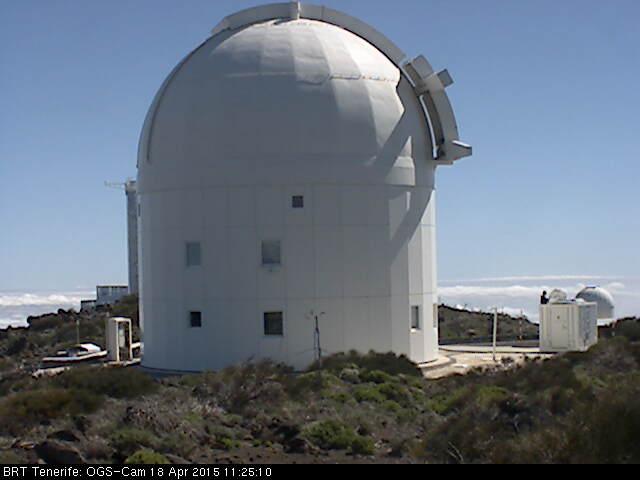 One team member took BigWhoop to Observatorio del Teide
As a team, we believe in BigWhoop and we will keep on working on it. One team member took a sensor device with him on a measurements campaign of his work and monitored the spectrum on his free time next to the Teide volcano on Tenerife. The scientific paper about the project was selected for the International Astronautical Congress 2015 in Jerusalem and we will present the Space Apps Challenge with “Opportunities of an open-source global sensor network monitoring the radio spectrum for the (new) space community” during the SPACE COMMUNICATIONS AND NAVIGATION SYMPOSIUM. And lastly, BigWhoop will serve as the ground station application for the Distributed Ground Station Network project also related to shackspace. There, it will help us tracking and communicating with small satellites globally and continuously and thus helping the satellite operators to get their positions and payload data faster than other systems.
Concludingly, BigWhoop and the NASA Space Apps Challenge was fun and a great experience. We learned so much during the event, we felt to be part of a global community, work(ed) on solving an important problem and started a project that can become even more than we can currently imagine. We as the local organizer and team will definitely apply for Space Apps Challenge 2016 again and bring it back to Stuttgart for you to tackle new challenges. We hope, that you like our BigWhoop project as much we do and give us your vote during the People’s Choice awards and make it win the space challenge!
Links:
[list=]bigwhoop.aerospaceresearch.net
vote for #BigWhoop
code on GitHub.com/aerospaceresearch/dgsn_bigwhoop
follow twitter.com/dgsn_bigwhoop[/list]
[Remaining Photos]
One team member took BigWhoop to Observatorio del Teide
As a team, we believe in BigWhoop and we will keep on working on it. One team member took a sensor device with him on a measurements campaign of his work and monitored the spectrum on his free time next to the Teide volcano on Tenerife. The scientific paper about the project was selected for the International Astronautical Congress 2015 in Jerusalem and we will present the Space Apps Challenge with “Opportunities of an open-source global sensor network monitoring the radio spectrum for the (new) space community” during the SPACE COMMUNICATIONS AND NAVIGATION SYMPOSIUM. And lastly, BigWhoop will serve as the ground station application for the Distributed Ground Station Network project also related to shackspace. There, it will help us tracking and communicating with small satellites globally and continuously and thus helping the satellite operators to get their positions and payload data faster than other systems.
Concludingly, BigWhoop and the NASA Space Apps Challenge was fun and a great experience. We learned so much during the event, we felt to be part of a global community, work(ed) on solving an important problem and started a project that can become even more than we can currently imagine. We as the local organizer and team will definitely apply for Space Apps Challenge 2016 again and bring it back to Stuttgart for you to tackle new challenges. We hope, that you like our BigWhoop project as much we do and give us your vote during the People’s Choice awards and make it win the space challenge!
Links:
[list=]bigwhoop.aerospaceresearch.net
vote for #BigWhoop
code on GitHub.com/aerospaceresearch/dgsn_bigwhoop
follow twitter.com/dgsn_bigwhoop[/list]
[Remaining Photos]
|
|
| Panda antyvirus - false positive |
One of our volunteers noticed me that Panda Antivirus recognise our application as potential dangerous (virus).
Our application is not a virus and is not dangerous for your systems. This is 'false-positive' reaction of Panda...
|
|
| Application update |
I have found (and solved) major bug in checkpoint loading function.
Update your application to version 0.03 in manager, please.
|
|
| The first scientific outcome! |
I have a pleasure to announce that the first article of the Universe@home project is finished! It appeared today on the http://arXiv.org, which is the official place for posting scientific articles. The writing can be found here: http://arxiv.org/pdf/1503.08745.
On behalf of the team I would like to thank all the volunteers who participated in the Universe@home test project. We hope that this is only the beginning and you will still help us in comprehending the Universe.
Shortly, I will provide you with a summary of the work written in the less formal language but meanwhile I encourage you to take a look. Our project is mentioned there a few times. Especially, please note the acknowledgements.
____________
Grzegorz Wiktorowicz
Astronomical Observatory
University of Warsaw
|
|
| New application tests |
Hello,
On the server are new application which cannot be send to production stage because of quite high error rate.
I have to send bit bigger set of WU's to find out where the problem is, so please update project in your managers to be sure that you have xray v0.02 on Linux based computers.
|
|
| RiojaScience's end? |
|
Hi all:
Bad news, It is hard to say that we stop riojascience project.
Triqct project is end and we are not able to launch a non-beta version of VENUS or others programs. This last is due to technical, economical, and personal issues: riojascience's team is not big and smart enough to give a quality service and feed the hungry volunteers.
However, the interrogation mark at the subject means that we hope that it is a temporally (?) shutdown. Maybe in the future riojascience comes back.
Only to say thanks all of you ...
Best,
riojascience's team.
|
|
| Correlizer@Home |
|
We will be back in operation as soon after we update/test the system and applications!
|
|
| OpenMalaria v33 on beta |
|
Dear users,
We have just updated the Beta application on malariacontrol.net to version 33 of our simulation software, OpenMalaria. At the same time we have started some new jobs to take advantage of the features in this version of the software.
Since several users reported problems with the 64-bit Windows version of the app added in the last Beta update, this has been disabled and we have reverted to using the 32-bit version on 64-bit Windows.
- Malariacontrol.net team
|
|
| Project News 17 Dec 2014 |
| ABC@home will be down for a few hours (at least) while we migrate to a new machine/setup. |
|
| Recent problems |
|
Hi there,
recently, we experienced some unfortunate problems:
1. The server hardware is old and can barely deal with the increasing load. This frequently leads to an unresponsive server. Website visitors are mainly affected since the boinc clients deal with the problem by trying to reconnect later on. The reconnects increase the problem additionally.
2. After getting back from two weeks of vacation, I realized that parts of the dDM database crashed and had to be restored. As far as I can see, we suffered no loss of important data. Maybe, some changes of user profiles were not stored.
3. The amount of dDM data increases steadily and the corresponding backup takes much more time than in the early stages of the project. As a result, the announced maintenance periods are no longer sufficient. I will think about a new backup strategy.
4. Some users reported about validation problems. I guess, this was due to the issues mentioned above. Right now, the validation of WUs is almost finished.
I apologize for any inconvenience caused by these problems.
Cheers,
Nico
|
|
| News |
Have you tried these? (scroll down for Android and Linux etc.?
https://boinc.berkeley.edu/download_all.php
|
|